

Nepal · Central Asia
Trip code: RTWalking the Annapurna Foothills
From
£1,360
Was £1,660 Save £300
Prices and availability are confirmed by our regional travel experts.
View dates & prices Call to bookYour adventure
Walking the Annapurna Foothills
Trip highlights
Why we love this trip
Why we love this trip
KathmanduExplore the temples and bazaars of Nepal's ancient capital.
Chitwan National ParkSearch for the rare one-horned rhino and other species in this sprawling park.
PokharaRelax by the lake surrounded by mountain vistas in this tranquil city.
Day by day
Itinerary
Select an option to view its itinerary. Contact us to confirm which itinerary applies to your departure.


Included Meals: Breakfast

Included Meals: Breakfast

Included Meals: Breakfast, Lunch and Dinner

Included Meals: Breakfast, Lunch and Dinner

Included Meals: Breakfast, Lunch and Dinner
Included Meals: Breakfast and Lunch

Included Meals: Breakfast
Included Meals: Breakfast, Lunch and Dinner

Included Meals: Breakfast, Lunch and Dinner


Included Meals: Breakfast
Included Meals: Breakfast
Included Meals: Breakfast
Route overview
Trip map
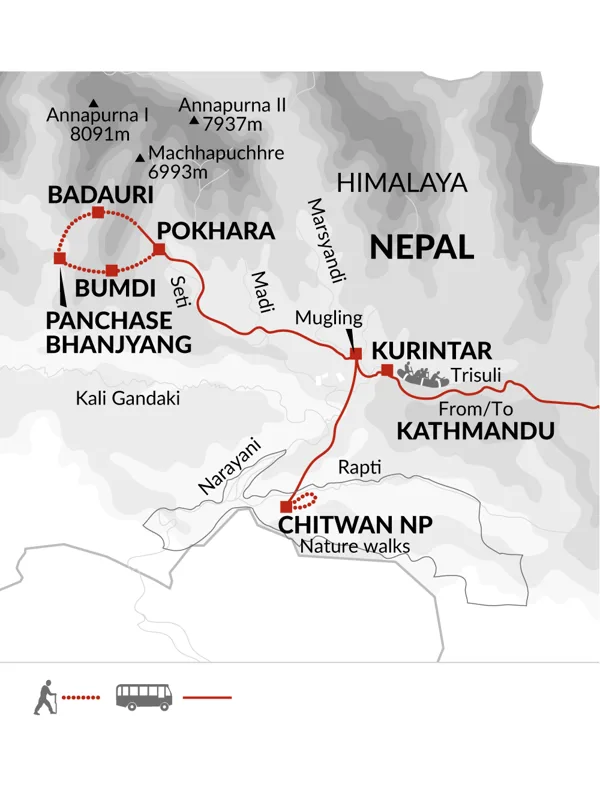
Activity information
Walking information
Walking
Grade: Moderate
Maximum altitude: 2,600 m
Included in your trip
What's included
Meals
- 12 breakfasts
- 6 lunches
- 5 dinners
Staff
- Naturalist(s), Driver(s), Porter(s), Explore Tour Leader
Transport
- 4WD
- Bus
Accommodation
- 7 nights Comfortable Hotel
- 3 nights Simple Teahouse
- 2 nights Comfortable Lodge
During this tour, we stay in a mix of comfortable hotels and simple teahouses. While our accommodation has been chosen with comfort, location and authenticity in mind, it's worth noting that standards will differ from home. Although the welcome will always be warm, service levels might be less efficient than what you're used to.
Tea houses in Nepal were originally local homes where a family had opened its doors to visitors, offering them a drink, a simple meal and a place to sleep for the night. Over time, these developed into a homestay-hotel hybrid and the concept of the 'tea house' was established. The tea houses we use usually feature a twin room with a bed, mattress, pillows and a blanket. For extra warmth, bringing your own sleeping bag is recommended.
Occasionally, when there is a larger group and the trails are very busy, you might need to share a triple or even quad room. Tea houses are sometimes likened to 'indoor camping' - there is no central heating, and the shared toilet and shower facilities will be basic (there may be a squat-style toilet and hot water is not always available).
Due to environmental protection regulations within the conservation area, the teahouses no longer provide heated communal areas using traditional wood fires. Gas heating may be available in the communal area for an additional charge, depending on the number of guests staying. If required, this cost is collected directly by the teahouse.
Throughout the trek, there will be a range of Nepali, Chinese and some Western dishes provided. Vegetarians are well catered for. A comprehensive range of hot and cold drinks will also be available.
Using tea house accommodation is a great way to meet the kind-natured people of Nepal whilst helping to support the economy in these remote mountain communities.
Suitability
Is this the trip for you?
- We've graded this trekking tour as moderate - you should have a good level of fitness and a love of the outdoors to take part.
- At Explore, we choose not to fly within Nepal, which unfortunately means we can only cover a limited amount of ground. We made this decision as Nepal's airlines are on the EU's air safety blacklist and we can't justify adding an internal flight at the risk of our customers. Road infrastructure in the country is expanding and we endeavour to see as much of the country as we can safely.
- With this in mind, our itinerary includes some longer driving days - check the day-to-day itinerary for exact driving times.
- As well as this, ongoing roadworks make for dusty conditions on the road - our time on the road is a bit of a rite of passage, brings us closer to life and gives us the chance to soak up Nepal's stunning scenery.
- During this tour, we make use of Nepal's teahouse accommodation. These give us an authentic taste of rural Nepal but it's worth noting that facilities are basic.
Plan your departure
Dates & prices
Choose a date below, then contact our team to confirm the latest price, availability and booking details.
| Departure | Return | Price | Booking |
|---|---|---|---|
| 01 Nov 2026 | 13 Nov 2026 | £1,660 Solo room£275 | Call to book |
| 15 Nov 2026 | 27 Nov 2026 | £1,360Was £1,660 Solo room£275 | Call to book |
| 03 Oct 2027 | 15 Oct 2027 | £1,675 Solo room£285 | Call to book |
| 17 Oct 2027 | 29 Oct 2027 | £1,675 Solo room£285 | Call to book |
| 07 Nov 2027 | 19 Nov 2027 | £1,675 Solo room£285 | Call to book |
| 14 Nov 2027 | 26 Nov 2027 | £1,675 Solo room£285 | Call to book |
Departure
01 Nov 2026
Return 13 Nov 2026
From
£1,660
Departure
15 Nov 2026
Return 27 Nov 2026
From
£1,360
Was £1,660
Departure
03 Oct 2027
Return 15 Oct 2027
From
£1,675
Departure
17 Oct 2027
Return 29 Oct 2027
From
£1,675
Departure
07 Nov 2027
Return 19 Nov 2027
From
£1,675
Departure
14 Nov 2027
Return 26 Nov 2027
From
£1,675
Practical information
Your questions answered
Information for: 2026
\b Patan - a half-day sightseeing trip to Patan, one of the three royal cities in the Kathmandu Valley. The city is known for handicrafts and carvings and is home to more than 1000 monuments. US$ 35
Swayambunath (Monkey Temple) - a half-day sightseeing trip to Swayambunath (Monkey Temple), a 1500-year-old UNESCO Buddhist Shrine. US$ 25
Rafting on the Trisuli - a half day white water rafting trip. No previous experience required. Includes all permits, services of experienced river guides, helmet, life jacket and lunch. US$ 70 (minimum number of participants is 4)
The prices stated are based on a minimum number of participants (4). Please be aware that the optional excursions can run with fewer people, but the price may be higher. Likewise, a slightly reduced price may be applicable where the participation is greater.
These excursions are generally run via our agent in the country. Local companies may offer similar excursions at a lower price. Should you want to use these companies, please be aware that a lower price may mean that not all costs are included (entrance fees, etc.) or services will not operate at the same safety and quality standards.
Local crew
In order to make things easier for you, the Tour Leaders may organise a group's tips kitty and if this is the case, they will account for it throughout the tour.
Tour leader
Nepal
Currency: Nepalese Rupee (NPR)
US$ or GBP.
Where to change: In major cities and towns
ATMs: Although you may occasionally find cash machines these are very unreliable - do not rely on plastic!
Card notes: Credit cards are not generally accepted except in larger establishments in Kathmandu.
Credit cards accepted: No
While you are trekking, daytime temperatures will generally be warm. On this trek you do not go above 2500m, so although you will need a sweater or fleece for the evenings, weather will generally be mild. However it can be chilly in the evenings, particularly between November and February, and at those times you will need warm weather clothing including a woolly hat and gloves, and a warm down jacket.
Long Trousers - For everyday walking, light cotton trousers are the most suitable. Knee length shorts are also acceptable Although comfortable, leggings are not recommended as they may cause offence to local people. Jeans are also not recommended as they are often difficult to walk in over longer distances and become cumbersome when wet.
Waterproofs - Breathable waterproofs not only protect against rain and wind but also stop you from overheating. They breathe and avoid condensation which you will experience from nylon waterproofs. Rain during the trekking season is fairly rare but can be heavy if it does happen.
Gloves - Especially useful around camp in the morning and in the evening in the winter months (December/January). Thermals or similar types are most suitable.
Socks - It is best to wear a pair of reasonably thick loop stitch socks. These help to protect your feet against blisters. Avoid nylon socks, they are abrasive, don't breathe well and can cause blisters.
Fleece pullover/jacket - You will need a fleece pullover/jacket for the evenings. Make sure that your waterproof jacket is loose enough to wear over your pullover or fleece.
Thin Shirts/T-Shirts
Laundry - Clothing may be left at the hotel in Pokhara to be washed and ironed ready for your return from trek.
For Chitwan safari - Lightweight and breathable clothing made from natural fibres, such as linen or cotton, is advisable, particularly if travelling during the hot months of March to May.
For wildlife spotting, bright coloured clothing or the colour white should be avoided. Neutral colours and earthy-toned clothes, such as khaki, beige, brown etc, will help you blend into the environment more.
Long-sleeve tops and trousers will help protect you from the intense sun and mosquitoes, especially during the jungle walks and safaris. Similarly, closed-toe walking shoes or walking trainers (with grip) will help you navigate the uneven terrain on the guided walks.
To protect you from the sun, a wide-brim hat will keep the sun off your head during the jeep and walking safari. Again, no brightly coloured or white hats as they do not blend in with the surroundings. Some choose to bring hat with a foldable neck protector to proect your neck from the sun.
A buff to protect your face from dust during the jeep safari, and also protect your neck, is strongly advised.
The morning activities can be carried out during chilly morning, especially if travelling during the Winter Season - November to February. In which case, warm layers, such as a fleece and jacket, will keep you comfortably warm.
It generally advisable to bring a waterproof jacket due to the unpredictability of the weather. This is essential in the months running up to Monsoon season (March - May).
We recommend taking the following items:
Sleeping Bag- The teahouses we use on trek all provide bedding and blankets however you will need a 4-season sleeping bag.
Water Bottles or Platypus/CamelBak style hydration system - Water along the trail must never be considered as drinkable. Boiled water will be provided in the morning during the trek to fill your water bottles and this should be either filtered by you (see below) or sterilised with chlorine dioxide tablets. If you dislike the taste of sterilised water, it is a good idea to add some powdered fruit juice. For environmental reasons, we do not encourage the purchase of bottled mineral.
Explore have partnered with Water-To-Go who supply 75cl personal water bottles with an in-built filter that eliminates 99.99% of all microbiological contaminants including viruses, bacteria, chemicals and heavy metals. https://watertogo.eu/partnerships/explore. You can drink direct from the bottle which has a drinking spout and fill these either from the tap or with the boiled water provided on trek. Your Water-To-Go bottle can then be topped up during the day from your standard water bottle.
Dry Bags - If you pack bits and pieces in a selection of bags inside your bag they will stay dry in case of rain and be easier for you to sort through in camp. Remember, the less you have to unpack in the evening, the less you have to repack each morning! A liner to pack inside your daysack is also a good idea.
Torch/Batteries/Bulb - A small torch is essential. Head torches are particularly useful. Only a limited selection of batteries may be available locally so bring spare batteries and bulb.
Toiletries - Try to keep heavy cosmetics etc to a minimum. Essentials are toothbrush/paste, bio-degradable soap, small towel, small nail brush and toilet rolls.
Binoculars - Useful for game viewing in Chitwan.
Sunglasses - A good pair of sunglasses is essential for protection against UV rays and glare.
Sun Hat, Sun Cream/Block and Lip Salve - Choose a high factor suncream (Factor 15 or more) to protect your skin against the sun at higher altitudes. A combination sunblock/ lipsalve is ideal for facial protection.
Personal First Aid Kit - Each trek carries an extensive first aid kit but no prescription medicines. You should have your own supply of plasters, aspirin, diarrhoea tablets and also a comprehensive blister kit, plus any other items you or your doctor feels advisable. (Please do not give medicines to local people without consulting the trek leader.)
Trekking poles - Trekking poles with rubber points are recommended. Swimsuit Spare Laces Chlorine Dioxide for water purification Anti-bacterial handwash
Ear Plugs- some may find it more comfortable to bring ear plugs with them so that while in hotels and teahouses they are not disturbed at night.
Insect repellent
Equipment Hire in Nepal - Almost every item required for a trek can be purchased or hired in Kathmandu and your Tour Leader can advise on the best shops to visit at your tour briefing. The costs of hiring are as follows:
Sleeping Bag (4 season)- Rs.150 per day
Down Jacket- Rs.100 per day
Equipment Hire and Trek Training Days in the UK - Trek Hire UK hire out a wide range of kit including quality sleeping bags, down jackets, therm-a-rest sleeping mats and walking poles http://www.trekhireuk.com. They also run regular trek training and preparation days from their base in the Surrey Hills, ideal for getting an indication of your overall fitness level and also covering advice on kit and altitude.
Luggage on tour
Main Baggage: The item of luggage used to carry all your belongings in the hold of the plane and used to store all of the items you don't need on trek. This can be left behind at the group hotel used prior to the trek.
Trek Kitbag: Customer on all of our treks in Nepal receive a free Explore kitbag on the tour prior to the start of the trek which is yours to keep. Approximately 80 litres in size it's ideal for all items you need to take on trek and the luggage preferred by our porters. The weight limit for this is 10kg but you will probably find that you do not need this much.
Daysac/Rucksack: 30-35 litres recommended. During the course of a trekking day, you do not have access to the luggage which is being carried for you by the porters. In any mountain region the weather can change rapidly and you must be equipped for this eventuality. Your daysac should therefore be large enough to carry waterproofs, fleece jacketweater, long trousers (if walking in shorts), warm hat and gloves, sun hat, sun cream, water bottle (minimum 1 litre) and your camera. Most people normally find that this adds up to about 2 to 3kg. Other optional items in a daysac might be a diary or a book to read at lunch time. On a few occasions it is also necessary to carry your own packed lunch. We advise you to take a waterproof rucksack cover or alternatively line the sack with a large plastic bag to keep the contents dry.
Advice on how and what to pack for the trek will be given at the tour briefing but it may be useful to do a trial pack before you leave home.
Luggage limit: 20KG
Nepal
A single-room option is available for part of this itinerary. It is not available on the following nights: Subject to availability for your departure. A single-room supplement applies.
- Night following Day 4 — Badauri Tea House
- Night following Day 5 — Panchase Bhanjyang Tea House
- Night following Day 6 — Bumdi Tea House
Nepal: An entry visa is required by UK, New Zealand, Australian, US & Canadian citizens and can be obtained on arrival at Kathmandu Airport and various international border crossings between Nepal and its neighbouring countries. This currently costs $30 USD for a 15 day visa, $50 USD for a 30 day visa and $125 USD for a 90 day visa. All visas are issued as multiple entry visas and are valid from the date they are issued. There have been reports of lengthy delays when completing the form to obtain the visa at the airport, especially during peak times. We therefore recommend that you fill in the visa information prior to arrival using the following link: https://nepaliport. immigration. gov. np/1. This will produce a receipt with a reference number, which you will need to print off and produce on arrival to obtain the visa.
Please note if you are filling in the form before you arrive, please do so only within 15 days of arrival as application forms are only stored for a maximum of 15 days.
Whether you are filling in the form on arrival or before, a passport-sized photograph for immigration is required along with the exact cash. Payment must be made in cash, UK sterling and US dollars are both accepted.
If you are ineligible for the visa on arrival or wish to obtain a visa before you travel, please refer to your nearest Nepal embassy.
Trekking Permits: A Trekkers Information Management System (TIMS) card and Annapurna Conservation Area Project (ACAP) permit will be applied for on your behalf by our local agents in Kathmandu. In order to facilitate this please send a digital copy of your passport size photograph prior to the trip or send it to the Tour Leader on the day of arrival during the tour briefing.